
Short answer from Ben, the Family IT Guy
I wouldn't give a child social media. I'd talk with my child about how these apps work and how they affect people. For messaging friends, I'd consider calls and texts with contacts we approve.
What does social media give a child?
Apps such as Instagram, TikTok and Snapchat let people share pictures, videos and messages. Your child may want an account because their friends use one, or because they've seen something they enjoy on it.
These apps can also show your child a stream of posts and videos, called a feed. The app uses software called an algorithm to decide what to show next, based partly on what a person watches and interacts with. That can include posts from people your child has never met. Depending on the app and its settings, people outside their circle of friends may also be able to contact them.
When new posts appear every time you scroll, there's no natural point where you've finished. The companies behind many of these apps make money from advertising. More scrolling gives them more opportunities to show ads, so I wouldn't expect the feed to help my child decide when to stop.
Why I wouldn't give a child social media
I think social media is like the meth of the digital world. It can feel good while you're using it, and I think it does more harm than good over time. I don't think it's good for adults either, and especially not for kids.
I'd treat a request for social media the way I'd treat a request to try smoking or alcohol. I wouldn't introduce my child to it. I'd hold that line even if the decision upset them, and I think kids will thank their parents for it when they're older.
What does the mental-health evidence show?
A 2025 study of 4,285 U.S. young people found that increasingly addictive social-media use was associated with more than twice the risk of reported suicidal behaviors, including attempts and actions taken to prepare for an attempt, compared with consistently low levels of addictive use. The study couldn't establish cause and effect. Its questionnaires asked about experiences such as finding it hard to stop using an app; this wasn't simply a comparison of hours online.
The chart below shows the broader U.S. death trend. Among children aged 10–14 who died, suicide accounted for 5.2% of those deaths in 2007 and 19.1% in 2018, calculated from WHO mortality data.
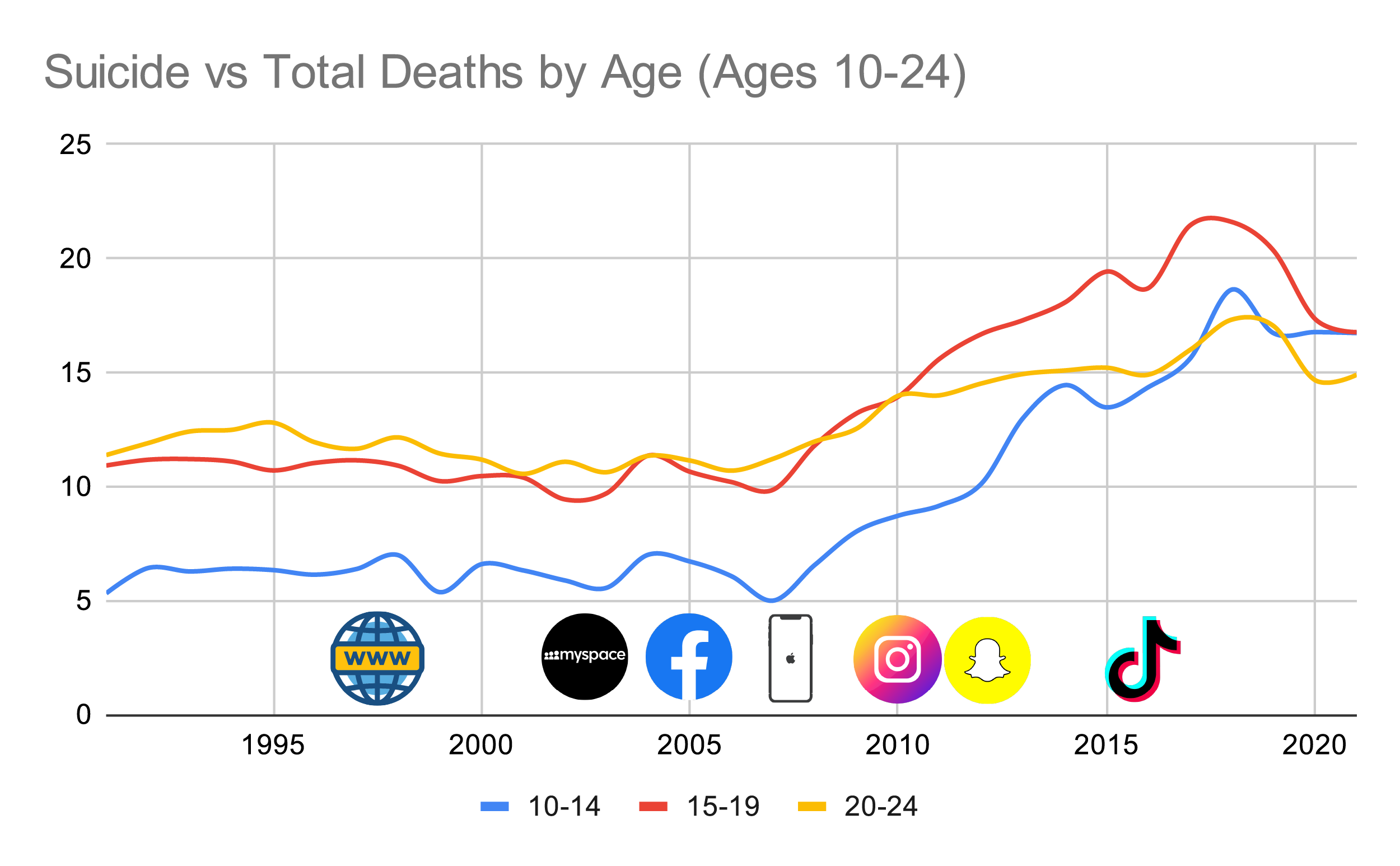
U.S., both sexes, 1990–2021. Each line shows suicides as a percentage of all deaths in that age group.
What I'd teach my child about social media
Keeping a child off social media doesn't mean they'll never see it. A friend might show them something on a phone, and they'll eventually make their own choices as adults. I'd want them to understand what they're looking at and how it could affect them.
I'd talk through examples with my child:
- Does the feed ever end? If it keeps offering another post or video, I'd explain why deciding to stop has to come from the person using it.
- How might what you see affect how you feel? I'd talk about noticing when posts, likes or comments leave them feeling bad, and putting the phone down to do something else.
- What would you do if someone pressured you to post, or if a comment upset you? I'd want my child to know they can come to me for help.
- Could someone else save or share what you post? Deleting a post doesn't remove copies other people have kept.
Those are conversations I'd keep having as my child grows up. I wouldn't use their answers as a reason to give them a social-media account.
Start with how you use your own phone
I'd look at my own habits before asking my child to change theirs. If I use social media, I'd show my child how much time I spend on it and talk about what else I could do with that time.
A phone's usage report can help with that conversation. On an iPhone it's called Screen Time; many Android phones offer Digital Wellbeing. These reports show how much time you spend in different apps.
I'd also let my child see me notice how an app affects me and put the phone down. They learn from what we do as well as what we say.
If your child wants to message friends
Talking with friends doesn't require a social-media account. I'd consider calls or texts with the contacts we've chosen, using the device options on the phone page.