
Family IT Guy · 28 August 2026
Will this Meta settlement reduce harm to kids?
The actual problems
Two things harm kids.
Addictive algorithms and messages from strangers. This settlement does not turn them off.
- Addictive algorithms. A feed that never ends. Scroll, and there is always more. Meta sells ads against it, so the longer your kid scrolls, the more Meta earns. That is the business.
- Messages from strangers. That is how predators reach kids. An adult poses as a kid, makes friends, and goes from there.
What this settlement does
The things that cause harm are not going away.
A two-hour daily limit with holes in it. An overnight block that leaves messaging on. A parent can loosen any of it.
- The two-hour limit leaves video and messaging out. Two hours a day across Facebook and Instagram combined. Video 22 minutes or longer does not count against it, and neither does messaging. A teen who hits the limit can keep watching and keep chatting.
- Overnight the app is blocked, except messaging. Midnight to 6 a.m., the feed and video are off. Messages keep working.
- Notifications stop from 10 p.m. to 7 a.m. Account-security alerts still come through, and a parent can change the hours.
- The recommendation feed stays on by default. By 27 December 2026 Meta must offer teens a plain time-ordered feed, and ask again every 90 days. Someone still has to choose it. Until they do, the algorithm picks.
- The daily limit and the overnight block expire in five years. Most of the rest of the agreement runs ten.
If Meta were trying to stop the harm
What is the shortest path to stopping the harm?
Suppose you run the company. You find out kids are getting hurt at global scale. What do you do?
Meta is paying at least $1.17 billion a year for ten years and doing none of that. Meta is not trying to solve the problem.
The actual solutions
Lead by example. This lawsuit is a distraction.
Do not wait for Facebook or Instagram to get safe. The controls on the devices you own are the ones that work.
Meta should answer for what it built, to the families it harmed, in court. A payment to state governments is not that, and neither one makes your kid safer. You are what makes your kid safer: what you teach them, what you model, the controls you turn on, and the community you keep them in. Every major phone, tablet, computer and game console comes with parental controls built in, at no extra cost.
What this settlement binds
Meta has to check the age of every user, not just teens.
By 27 August 2027, on every Facebook and Instagram account in the states that signed. The settlement took effect on 27 August 2026, the first business day after the judgment was entered.
"to each Meta SMP user in the Settling States" SMP means social media platform. Here that is Facebook and Instagram. Document 576-1, Section II.A.1. Court filing.
Meta does not have to ask for your ID or scan your face. It is allowed to guess your age from how you use the app, or to take an age signal from Apple's or Google's app store.
What the age checks are for
Age checks do not make your kid safer.
They do not turn off the feed. They do not stop the messages. All they change is who gets blamed.
- The app does not change. A 14-year-old who proves their age gets the same feed and the same messages as one who does not.
- To find the children, it has to check everyone. That means IDs, face scans, or tracked behavior on adults too. In October 2025 Discord said about 70,000 government ID photos may have been exposed through an outside vendor, and those IDs came from people appealing an age check. On 1 September 2026 the FBI opened an investigation into a criminal marketplace selling scans of more than 153 million driver's licenses, apparently taken from one identity-verification company.
- This is censorship, and age is only today's rule. Censorship is one party deciding what another person is allowed to see, and having the power to enforce it. An age check works out who you are, then decides what you can reach. That is the same thing. Only the rule is different. The check can be applied to any other fact about a person, because it was never about age. And the platform does not write the rule. It is written by whoever can order the platform to change it: a state legislature, a regulator, a court, or a foreign government in a country where the platform operates.
- It ends anonymous reading, for adults too. Right now you can look something up without anyone knowing it was you. Once you have to prove who you are to reach information, that is over. People read differently when reading is on the record, and nothing has to be blocked for that to happen.
- It protects the company, not your kid. A company that checked your ID can say it did what the law asked. That helps if it gets sued. It does nothing for the kid, who is still using the same app.
This settlement pays to spread those checks. The extra $5 billion arrives only if Snap, TikTok and YouTube are also put under age checks for teens at least as strict as Meta's. If that never happens, the states forfeit the money and Meta keeps it.
BBC News, 9 October 2025 · Krebs on Security, 1 September 2026 · Document 576-1, Section I.DD
Are they let off the hook
Meta agreed to pay. Meta admitted nothing.
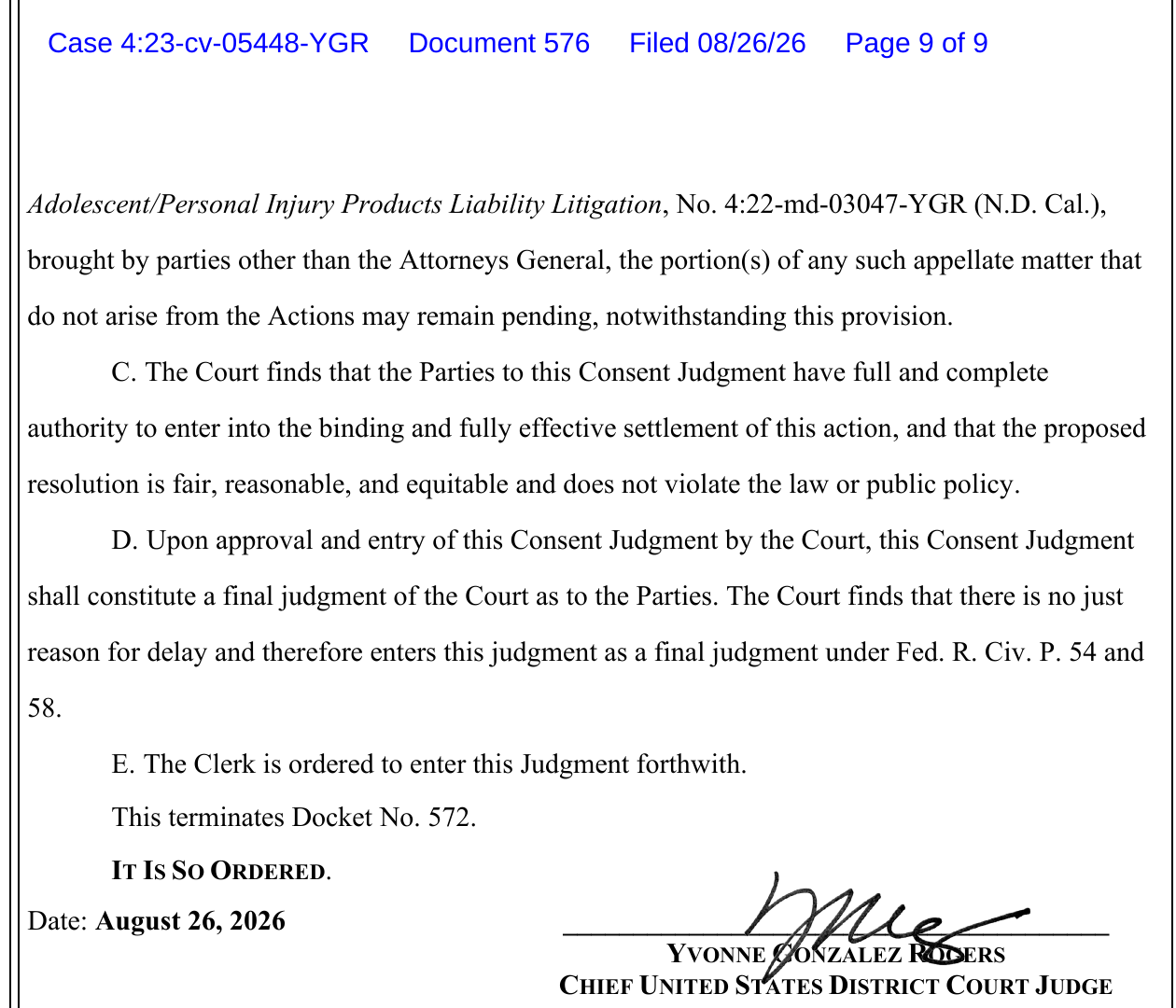
"do not constitute an admission by Defendant of any liability, wrongdoing, or violation" Document 576.
The states that signed are done with this case. Families, schools and tribes still have theirs. 47 states joined, plus D.C., Puerto Rico, American Samoa and the Northern Mariana Islands. Texas settled separately for more than $1 billion. New Mexico and Florida did not.
The number
A ten-year payment to governments.
The headline is about $18 billion. States may use it for any lawful purpose under the attorney general's authority, including fees and enforcement.
How we enforce it
Only the parties and the court.
- You cannot enforce this. Only the states can. If Meta misses a default, a parent, a school, or any private plaintiff has no standing to do anything about it. The judgment's own words are "no private right of action."
- Notice, then wait. Written notice. 30 days to answer. 15 business days of discussion. Then court. A state may skip that if it believes there is a public-health threat.
- Meta pays the auditor. Up to six state attorney general offices oversee it. Reports go to the parties. The public gets a short summary.
In five years
Some parents will think Instagram is safe now.
They will think Meta is trying to help. Neither of those things is true.
Nothing in this settlement changes the two things that do the harm.